
Electrophysiology

Electrophysiology
We can help formulate, design and execute electrophysiological experiments to resolve the functional physiological aspects within your research projects. We also offer training and support to researchers, allowing them to conduct experiments independently. Finally, for experimental research approaches not currently available, we will expedite collaborations with external labs and assist as intermediate spokesperson.
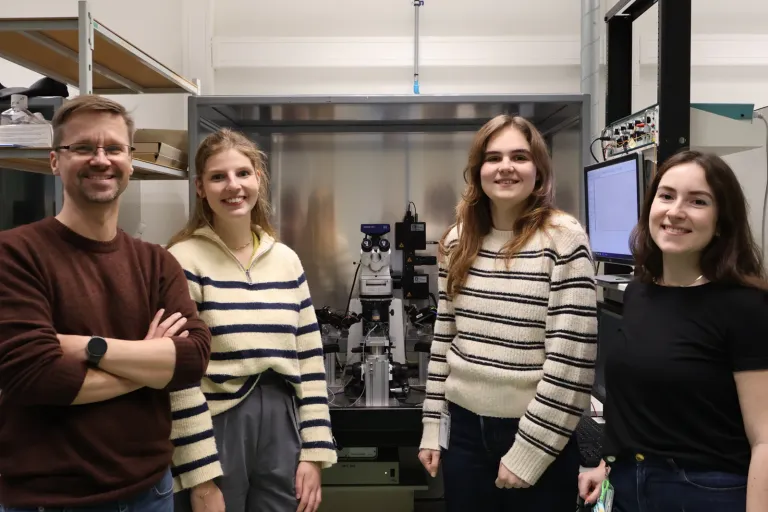
The facility includes multiple advanced electrophysiology rigs, ranging from acute slice setups with scanner‑based or field‑of‑view‑based 1‑photon optogenetics to a dissociated‑cell system equipped for rapid fluorescence imaging and fast solution switching. It also features an integrated multiphoton (2p/1p) imaging–electrophysiology platform, supported by all essential preparation tools such as a vibratome, pipette pullers, microscopes, and dissection equipment.
The Electrophysiology Unit is headed by Keimpe Wierda (keimpe.wierda@vib.be).
Take a Virtual Tour
What do our electrophysiology facilities look like? Check out some of our facilities at the VIB-KU Leuven Center for Neuroscience via our 360° virtual tour.
Let's show you around!
Get to know some of the incredible tools and people driving the Electrophysiology Unit through this vlog with Keimpe Wierda, Electrophysiology Expertise Unit Lead.
Meet our Experts
In the Spotlight
Check out some recent collaborations between the Electrophysiology unit and labs at the VIB-KU Leuven Center for Neuroscience.
A dynamic gene regulatory code drives synaptic development of hippocampal granule cells
Sci Adv. (2025) in collaboration with the Joris De Wit Lab
Synaptic neoteny of human cortical neurons requires species-specific balancing of SRGAP2-SYNGAP1 cross-inhibition
Neuron (2024) in collaboration with the Pierre Vanderhaeghen Lab
Accumulation of APP C-terminal fragments causes endolysosomal dysfunction through the dysregulation of late endosome to lysosome-ER contact sites
Developmental Cell (2024) in collaboration with the Wim Annaert Lab
Electricity In the Brain
At the interface where electrical signals meet the structural complexity of the brain lies the field of electrophysiology. By measuring and manipulating electrical properties of cells and neural circuits, electrophysiology reveals how biological systems function in real time and how molecular and cellular changes translate into behavior and disease. Electrophysiology enables us to study these electrical phenomena in great detail and allows us to understand how electrical signals are used in biology.
How is neuron network activity affected in early Alzheimer's?
We support research groups with our electrophysiology expertise and facilities to collaboratively unravel the mysteries of the brain. Click the link below to experience one example of science and technology meet to produce excellent results.